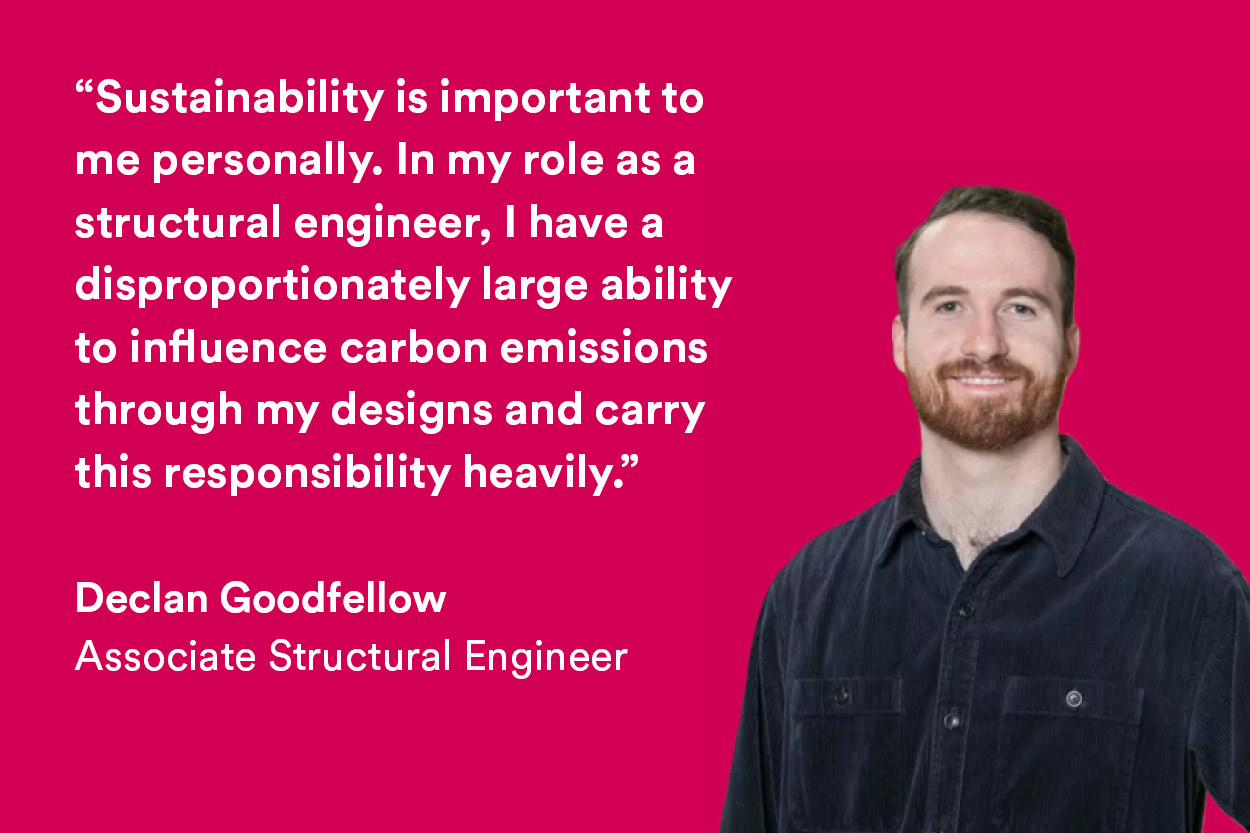
We’re introducing Declan Goodfellow in this edition of ‘Meet The Team’.
He joined us in October as Associate Structural Engineer after having been with Heyne Tillett Steel for 7.5 years prior.
Declan has a deep appreciation for the process of taking an idea and turning that into reality, and the collaboration that process brings. He has a genuine interest in sustainable design and making structures as efficient as possible without compromising on quality.
Since joining, you’ve well and truly thrown yourself into all things SD. It definitely feels like you’ve been part of the team for longer than you have. How have the first four months been for you?
It’s been great! It’s been very busy. The role is exactly as I’d expected and the team have been very welcoming. I’m stepping into more of a managerial role of the team than I had previously which has taken some getting used to, but it’s what I’d hoped for and positive so far.
Something that did surprise me though is the genuine offer of a decent work-life balance through flexi hours and remote working etc. You can clearly see how this benefits the team and in turn benefits SD as a practice.
What does your previous project work look like?
I’ve delivered some very technically challenging projects like building a student residential block on top of a live central London tube station; a full strip out and refurbishment of a luxury hotel in Mayfair where the footprint of the building was extended as well as the height of the building, with tube lines running directly beneath the site; and a significant office refurbishment and vertical extension which involved 97% of the existing structure being retained, including 61% of the steel requirements specified as re-used elements.
A key part of my approach to these projects was reviewing available archive and desktop information to develop an understanding of the history and construction of the buildings that have occupied the site. Followed by structural investigations and detailed analysis to understand the capacity and condition of the existing structure and ground conditions.
I look forward to tackling retrofit projects at SD with a similar approach in conjunction with our excellent early-stage BIM capabilities to help clients maximise the opportunities to develop their existing assets.
What was it that drew you to SD?
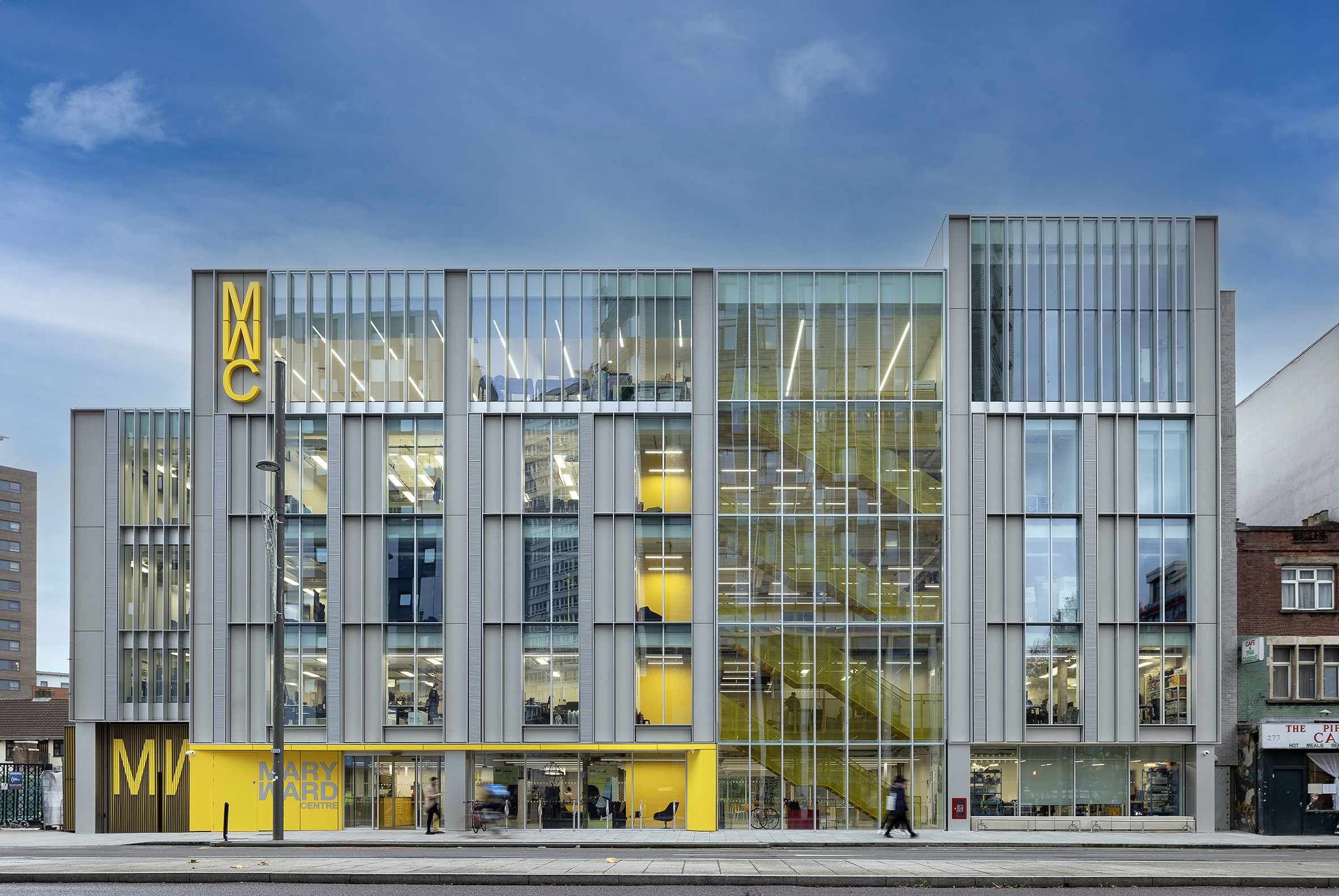
I first became aware of SD after reading the Mary Ward Centre article in the The Structural Engineer. I was impressed by SD’s approach and the outcome which resulted in retention of the majority of the existing structure and addition of two extra storeys on a building recommended for demolition.
Sustainability is important to me personally. In my role as a structural engineer, I have a disproportionately large ability to influence carbon emissions through my designs and carry this responsibility heavily. SD have signed up to the Engineers Declare petition and are part of the Engineers Re-Use Collective demonstrating their commitment to getting to net zero. In my first few months it has been evident that SD put their money where their mouth is, at the end of last year launched a guide on embodied carbon in domestic construction to raise awareness and drive positive change in this part of the industry. I look forward to continuing to drive the industry forward at SD.
Finally, my experience so far is predominantly within the commercial realm. SD works across a range of different sectors, and I wanted to broaden my skillset. I was also interested in the opportunity to build my own team in a growing practice. We have so many excellent people here and I aim to support them and also draw out their own expertise to the benefit of everyone.
What’s your approach to balancing client expectations and the architectural intent?
I’ve been very fortunate to work with some of London’s top developers and architects on several flagship projects. And in recent years I’ve been more involved in pre-purchase studies for clients – this is often the most important decision a developer will make. Getting the engineers involved earlier in schemes allows clients and developers to make informed decisions about development potential prior to committing significant funds to develop a design with a project team. It is also important from a sustainability perspective as it allows engineers to influence the extent of retention from an early stage. This is a side to engineering that I really enjoy and is something SD Engineers often get involved with.
You’ve joined us as Associate Structural Engineer, leading team Jolly – Konstantina and Arij. What’s the aspirations and ambitions for you, and for the team?
On a personal level, I want to grow our team. Not number of people in a certain number of years type growth. But develop and strengthen our skills and competence. Our team have such varied and interesting backgrounds, and I want to draw on that experience and knowledge share to get the best out of everyone.
We’ve got some exciting projects on the cards just now. Brick Street, The Beacon’s Auditorium, and Bermondsey Arches are just a few of the complex schemes being delivered by the team. All very interesting and quite large developments which will flex our creative muscles.

What’s something you’ve worked on at SD already that you’re proud of?
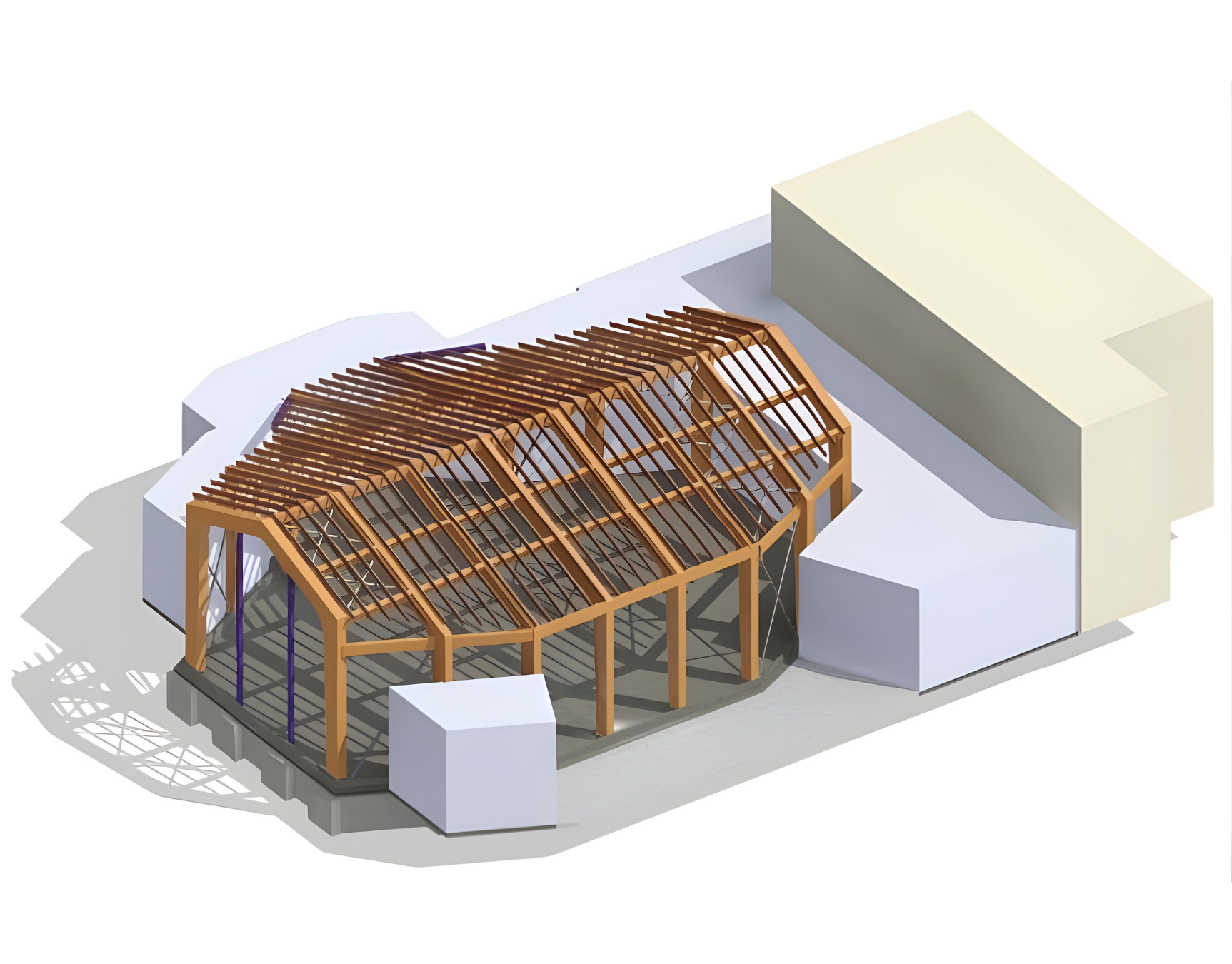
It’s been a very busy four months getting to know our projects, processes etc. But something I’m already proud of is The Beacon’s Auditorium in Horley. My previous work has predominantly been in the commercial retrofit sector and so this was the first larger-scale all-timber project I’ve designed. Learning about the practicalities of designing and building using a different material was so interesting and I’m looking forward to this scheme progressing.
What excites you most about the future of structural engineering?
Retrofits. And delivering them efficiently. Let’s be honest, that’s the agenda this industry must continue to push forward. The future of my profession is something I really enjoy – that excites me.
What advice would you give to younger engineers starting out?
Ask as many questions as you can and surround yourself with good people.
If you’re not getting the support you need, change your situation. Be proactive.
What do you get up to when you’re not working?
I love playing golf, video games, and travelling. Also hiking around hilly landscapes – takes me back to my Scottish roots!