A new auditorium, built using glulam portal frames, will extend Horley Baptist Church and cater for their growing congregation.
Client
Horley Baptist Church
Architect
CPL Architecture
Budget
Undisclosed
Status
Currently in design
Year
Photography
SD Engineers CPL Architecture Horizons3D
Download PDF
The brief called for a new auditorium building large enough to serve a growing congregation, connected to an existing building already occupied by Horley Baptist Church.
The primary constraint was achieving a wide, column-free interior with a pitched roof, without compromising the character of the existing building or the tight site.
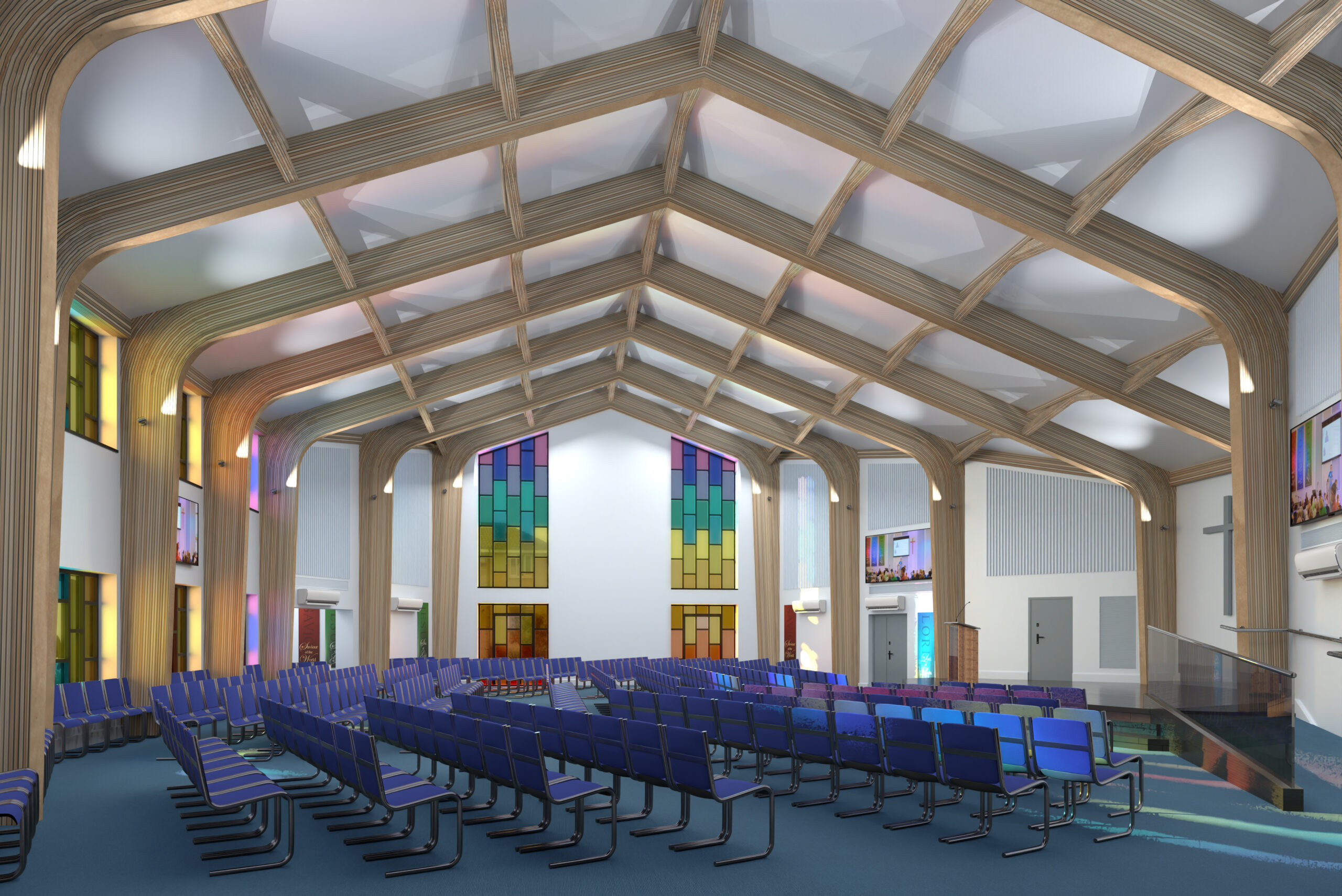
The structural solution centres on a glulam portal frame system. The frames carry lateral loads north-south, transferring wind and stability forces down through the cladding and perimeter beams at eaves level into the foundations. In the east-west direction, four vertical braced bays provide stability – structural options being investigated during the next stage of design include steel rod cross bracing, glulam bracing, or CLT racking panels.
The roof presents a particular coordination challenge. Wind loads from the east and west elevations transfer to roof level, where two wind trusses distribute forces to the vertical stability structure. An alternative approach – detailing the timber roof joists and plywood to act as a structural diaphragm – would remove the need for the wind trusses entirely, simplifying the roof build-up and potentially reducing cost and programme. Both options remain under review.


Above the stage, the portal frame cannot bear on columns, so the rafters are supported on a transfer beam instead. This introduces a lateral thrust force that needs a dedicated resolution: the rafters extend to the perimeter of the stage, where a steel box frame carries the vertical loads and transfers the thrust directly to the foundations. A straightforward detail, but one that required careful coordination between the structural frame and the architectural layout of the performance space.
Foundation design is governed by the presence of trees on site and the ground conditions beneath. Glulam columns will be supported on pad foundations in the clay, with depths confirmed once the arboriculturist’s survey is complete. The ground floor slab is suspended, with a ventilated void below providing heave protection – the void depth is subject to the same survey. The slab itself is a precast beam and block system spanning between mass concrete ground beams and strip footings. Where the new structure meets the existing building, we are reviewing whether existing foundations can be reused, which would reduce programme and cost if confirmed viable.
Below ground, the civil engineering design follows best practice under CIRIA C750 for the appraisal of existing drainage infrastructure. Surface water is managed at source where possible through a blue roof system. Where a blue roof is not achievable, existing below-ground infrastructure will be assessed for capacity, with extension of any existing attenuation tank as a fallback. Foul water capacity will be confirmed by calculation, with any necessary improvements detailed and connections to the wider network confirmed via Section 106.
