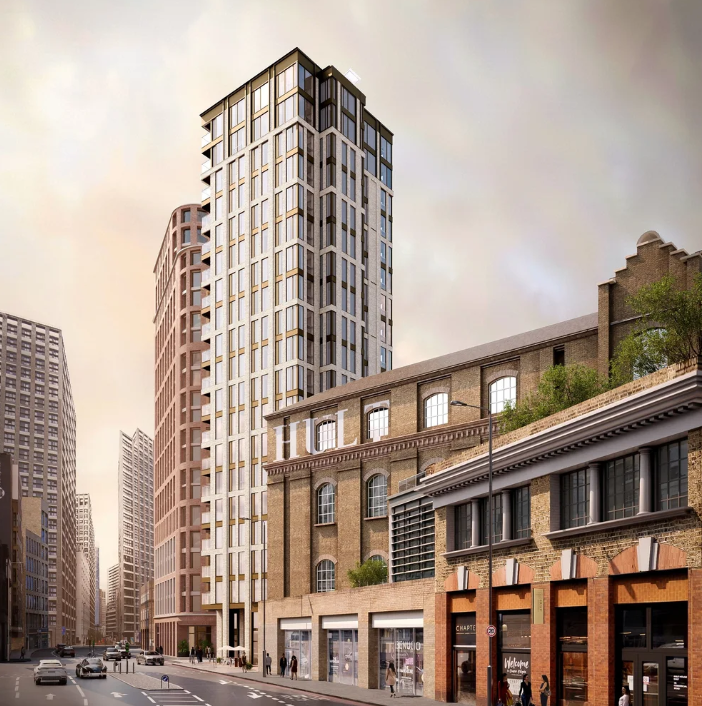
A 20-storey building in Whitechapel requiring careful coordination of civils elements before the structural design was fixed, collaborating closely with the architect and M&E engineer to deliver a coherent solution.
Sector
Client
CMT Construction
Architect
Shorten Architects
Budget
Undisclosed
Status
Currently on site
Year
Photography
SD Engineers Shorten Architects
SD Team
Alex O’Reilly Joe Cox Callum Nowell
Download PDF
Structural and civil engineering for a 20-storey residential development of 48 units in East London with a partial basement to accommodate plant requirements and additional commercial space.

The superstructure uses a reinforced concrete frame with flat slabs spanning between vertical columns and a reinforced concrete core. Vertical loads are transmitted directly onto the foundations down the core and columns, minimising the requirement for transfer structures.
There is only one transfer beam within the substation to support the corner of the building. Lateral loads are transmitted to the slabs by the cladding, which spans vertically between floors. The slabs span between columns and the core and uses diaphragm action to transmit lateral loads to the Reinforced Concrete core. The core acts as a vertical cantilever spanning up from the basement level with forces at ground level resolved into push-pull loads into the piles.


The drainage strategy responds to the height and configuration of the building and the constraints of connecting to the existing public sewer network.
The drainage design directs all surface water and foul drainage from above basement level to basement ceiling level, where it discharges to the sewer by gravity via a suspended pipework system. Where foul drainage originates at basement level and cannot drain by gravity, it is collected and pumped to basement ceiling level to connect with the rest of the suspended system.
For a building of this scale, the routing, falls, and fixings of the suspended drainage system at basement ceiling level must be resolved across all disciplines before structural elements are fixed. We coordinated this process throughout the design phase, working directly with the M&E engineer responsible for the above-ground drainage to ensure a coherent and buildable solution.
We managed all statutory authority engagement, leading liaison with the Lead Local Flood Authority (LLFA) and Thames Water to secure the approvals required to support the planning application. This included a pre-development enquiry to Thames Water to confirm sewer flow capacity, securing drainage-related planning consent, and agreeing a Section 106 agreement for the connections to the public sewer. A blue roof is also included as part of the SuDS hierarchy and LLFA requirements.