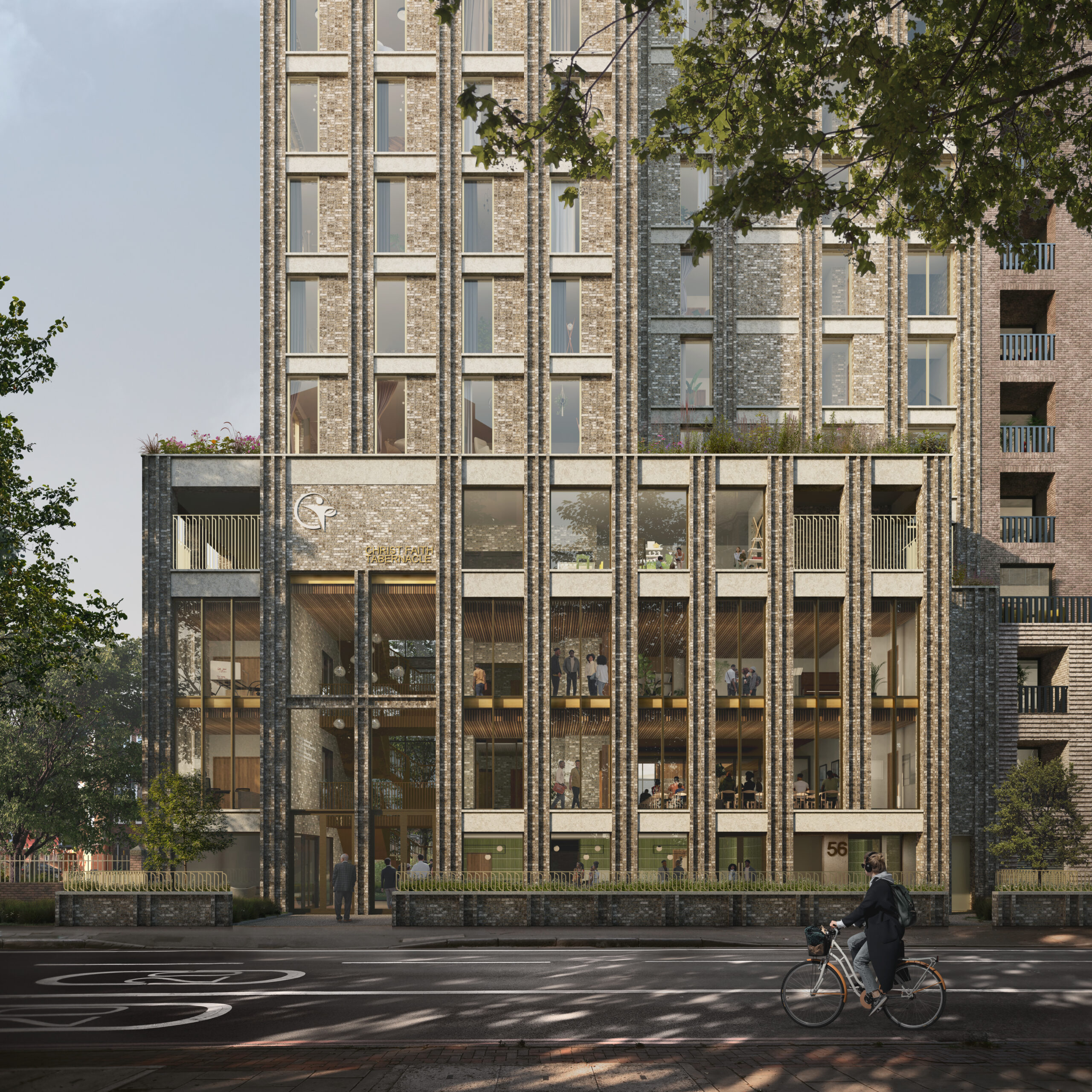
Christ Faith Tabernacle’s New Cross branch is being transformed into a new double-height church and community spaces with eleven storeys of residential accommodation above.
Client
Christ Faith Tabernacle International Churches
Architect
AWW
Budget
Undisclosed
Status
Submitted for planning
Year
Photography
AWW SD Engineers
Download PDF
The New Cross branch of Christ Faith Tabernacle (CFT) is a much-loved church. CFT had an ambitious vision to create a modern worship space that would better serve its congregation, provide flexible community facilities, and introduce new residential units that would help secure the church’s financial future.
Alongside architects AWW, we were appointed to deliver the design at this challenging urban site.
The site presented significant challenges and constraints. Bounded by highways on two sides and a neighbouring development, the available footprint had to be maximised to make the scheme viable.
Beneath the site is the most critical constraint: the proposed Bakerloo Line extension, with its tunnel crown 11 metres below ground. Two tunnels, each six metres in diameter, ran directly beneath, placing strict limits on where and how foundations could be built.
Transport for London (TfL) imposed an exclusion zone and set a hard cap of 50kPa on any additional ground loading.
At the same time, planning restrictions limited the building’s height to 11-storeys. Achieving the client’s aspirations within these constraints required careful negotiation, rigorous modelling, and innovative structural thinking.
From the very earliest stages, we engaged directly with TfL to ensure that foundation strategies would meet technical approval. We explored several scenarios:
- A shallow raft foundation supporting a lightweight steel and timber frame could stay within the loading limit, but only allowed for a seven-storey scheme.
- Excavating a partial basement to reduce soil loading opened the possibility of additional floors, but the complexity and cost of waterproofing, retaining walls, and level changes threatened to outweigh the benefits.
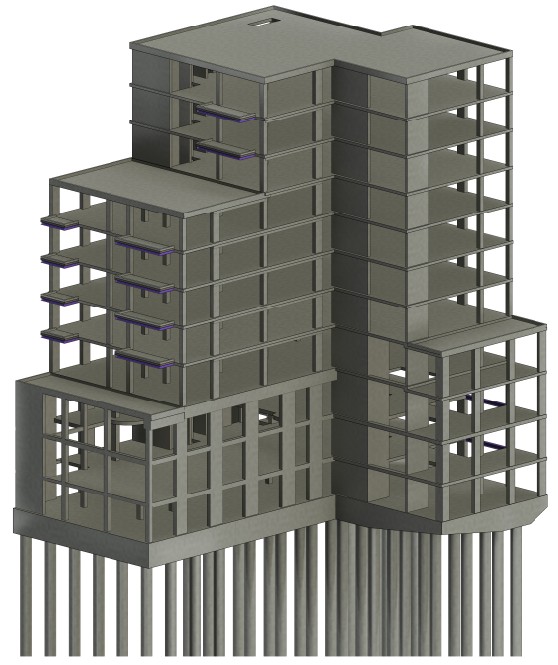
- The most appropriate solution emerged in the form of a piled raft foundation. By sleeving piles 30–35m deep and transferring loads beneath the tunnel exclusion zone, the building could reach its full planning height of 11 storeys.
Working with geotechnical consultants, we modelled the ground and raft interaction in detail. The piled raft solution proved to be the most efficient: it permitted the use of a heavier reinforced concrete frame that not only provided architectural flexibility but also improved acoustic performance, a key benefit for the double-height auditorium.
The final design is a reinforced concrete frame, coordinated carefully with the architectural layout so that columns are embedded within walls and spaces remain clear and flexible. The church auditorium — a 9.5m wide, open-plan space seating nearly 250 people — is achieved using robust transfer beams that carry loads from the upper residential floors to the building’s perimeter.
The raft foundation is being optimised with ribs and thickenings where required. This approach reduces concrete volumes, lowers embodied carbon, and delivers significant cost savings without compromising stiffness or safety.
From ground to the fourth floor, the building accommodates the church and community spaces, including the dramatic double-height hall. Above, residential units occupy up to the 11th floor, with stepped-back terraces at higher levels to provide amenity space and to soften the building’s profile from street level.
Our civil engineering design responds to our Flood Risk Assessment which determined the site to be low risk. We designed a Sustainable Drainage Strategy including permeable paving to reduce runoff, with a geocellular attenuation tank at the front to treat, store and control water discharge.
Given the site’s busy location on New Cross Road, construction logistics and buildability issues were addressed at planning stage. We highlighted restrictions on working hours, noise control, and safe management of traffic and pedestrian access to ensure minimal disruption to the neighbourhood.
By engaging TfL early and exploring various foundation strategies, we were able to de-risk the scheme and give the client confidence from the outset. The piled raft solution unlocked the full potential of the site — maximising developable area, delivering robust acoustic and structural performance, while controlling costs and embodied carbon.
This project demonstrates how proactive engineering, combined with early collaboration and careful modelling, can transform a highly constrained urban site into a community asset and revenue-generating development.